Study facts at a glance
Laser-study population: Thirteen patients completed the study; the abstract does not report the original randomized total or the number in each arm. Source 1
Controlled comparison: Patients were randomized to topical postresurfacing regimens with or without GHK-Cu after CO2 treatment around the mouth. Source 1
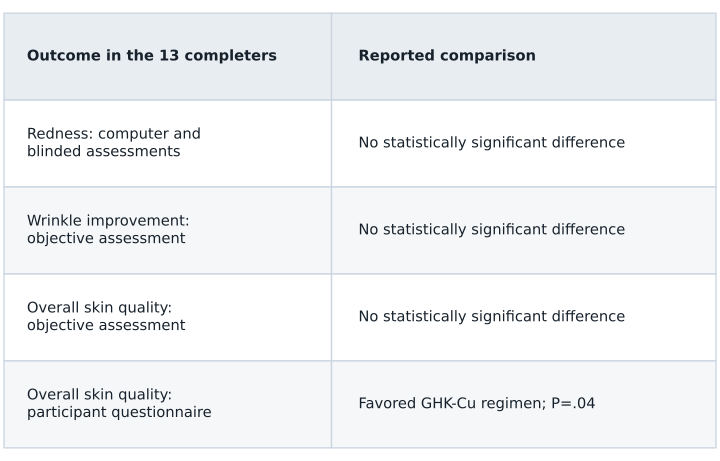
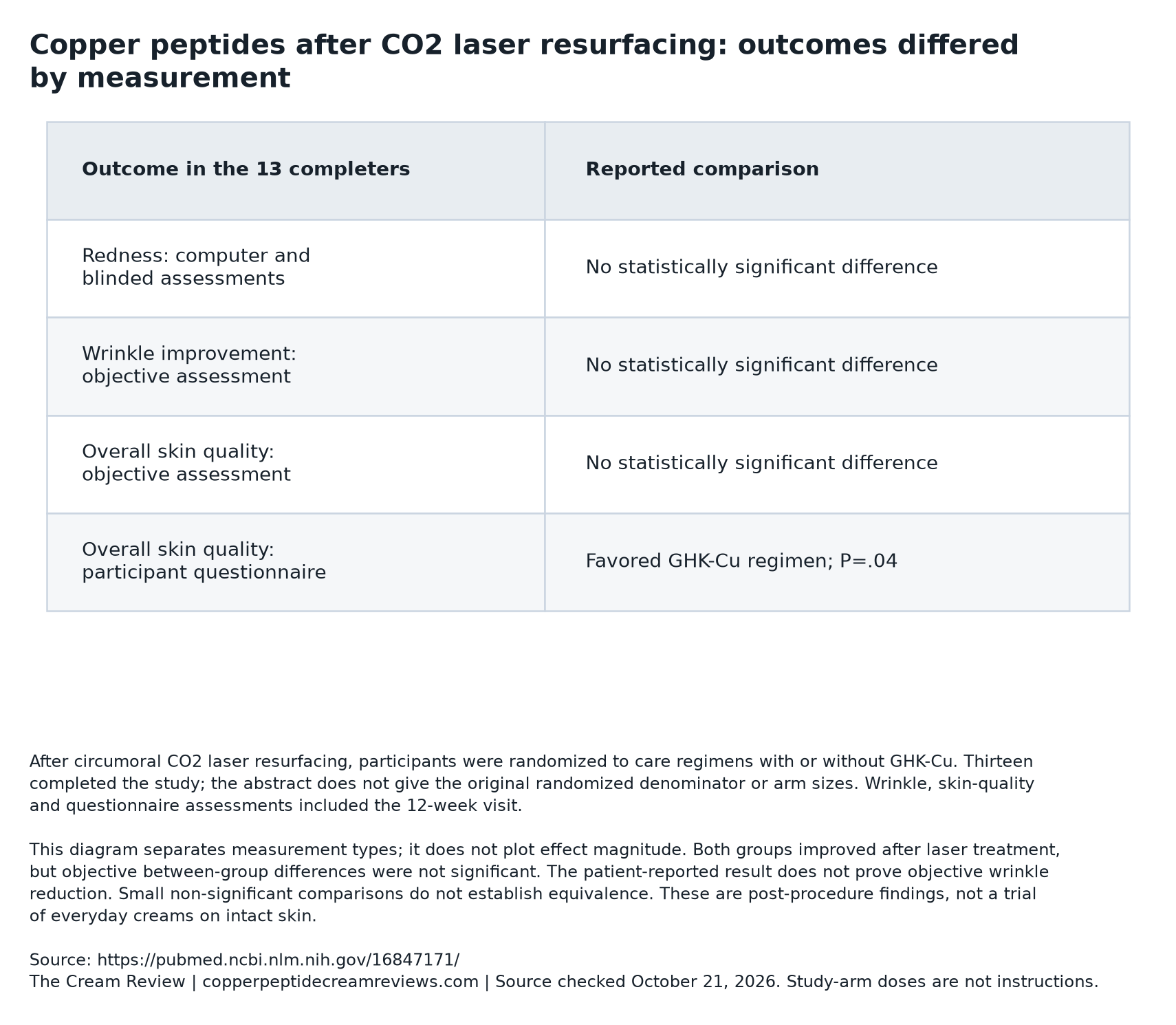
Externally assessed outcomes: Between-group comparisons did not show statistically significant advantages for redness resolution, wrinkles, or overall skin appearance. Source 1
Patient-reported outcome: A questionnaire favored the GHK-Cu regimen for perceived overall skin-quality improvement, with P = .04. Source 1
Separate wound evidence: The ulcer trial enrolled 181 participants overall, but its immediate-treatment plantar-ulcer findings concern a restricted comparison, not all 181. Source 5
The experiment tested an addition to laser aftercare
The laser report assessed wrinkle and appearance outcomes at 12 weeks. Redness was evaluated with computer analysis and blinded evaluators, and patients completed a validated questionnaire before treatment and at follow-up. Both groups improved after resurfacing. The abstract does not designate a single primary endpoint, identify the GHK-Cu concentration, or provide the regimen details needed to reproduce the comparison.
The central methodological distinction is between improvement after an intervention and improvement attributable to an added ingredient. A before-and-after photograph can show substantial change while leaving the ingredient’s contribution unresolved. When both groups receive the major procedure, the controlled question becomes whether adding the topical regimen produces an extra benefit beyond the shared treatment and recovery process.
That makes the comparator more informative than a simple testimonial. It also makes the conclusion narrower: this was not a test of everyday cream use on untreated facial skin. Our guide to copper-peptide clinical claims applies the same reading rule: identify what both groups received before assigning credit to the ingredient that differed.
Source 1
Read the underlying chart data: download CSV or download the source-labeled chart.
Thirteen completers leave important uncertainty
The laser abstract does not report the original randomized total, arm counts, or attrition. It also omits between-group effect estimates, confidence intervals, adverse-event counts, and funding information. Those omissions prevent a precise assessment of the size and uncertainty of the added benefit or harm.
A confidence interval describes a range of effects compatible with the data under a statistical model. Without one, readers cannot tell whether a nonsignificant comparison was tightly centered near no difference or broadly compatible with both benefit and harm. This is why a small study without a significant result does not establish equivalence. Equivalence requires a justified margin defining how small a difference would count as practically unimportant and an analysis designed to assess that margin.
Completion also matters independently of sample size. If participants leave a trial, the reasons can affect interpretation, particularly when departure is related to discomfort or disappointing results. That is a methodological possibility, not a claim about what happened here. The appropriate response to missing attrition information is to leave the question open rather than silently assume that every randomized participant completed follow-up.
Source 1
A satisfaction result is meaningful without becoming a wrinkle result
Patient experience and independent assessment measure different aspects of treatment. A questionnaire may capture an overall impression that is not represented by a redness measurement or wrinkle assessment. That does not make the questionnaire invalid. Conversely, a favorable patient rating does not establish that a particular physical feature changed more.
The reported P value is not the probability that the cream works, nor does it measure the size of an improvement. It describes how unusual the observed result would be under the specified null model and analysis assumptions. A practically small difference can sometimes be statistically significant, while a potentially meaningful difference can fail to reach significance in a small sample.
Several assessed outcomes also create a question about multiplicity: how were the analyses planned, and was any adjustment intended? The accessible abstract does not resolve that question. It would be inappropriate either to dismiss the questionnaire finding automatically or to treat it as decisive proof. The responsible reading is an endpoint-specific signal whose magnitude and robustness remain uncertain.
How to keep the laser study’s outcome categories separate
Source 1
The wound trial provides context, not a facial-cream verdict
The separate ulcer trial was randomized, evaluator-blinded, and vehicle-controlled. Participants had diabetes and neuropathic ulcers; all received standardized wound care, including debridement, pressure-relieving footwear, and education. The immediate component compared topical 2% GHK-Cu gel with vehicle for up to eight weeks, followed by six weeks of observation. The delayed component used four weeks of vehicle before eight further weeks of vehicle or 2% or 4% gel.
These are historical study arms, not application instructions. A vehicle is the formulation base without the studied active ingredient. Using it as a comparator helps separate the active ingredient’s contribution from effects of the base and shared care. It does not make the result independent of the surrounding clinical program.
The relevant transfer problem is substantial. An open ulcer, a recently resurfaced area, and intact facial skin are different treatment settings. Even when the ingredient name is shared, the tested product and clinical question are not. The companion analysis, copper peptides in diabetic ulcers, examines the wound endpoints in greater depth rather than treating them as cosmetic outcomes.
Source 5 Source 1
Wound-area percentages require the right denominator
In the immediate-treatment plantar-ulcer comparison, median area closure was 98.5% with active gel versus 60.8% with vehicle, reported as significant at P < .05. That is a 37.7-percentage-point difference between medians of area closure—not a finding that 98.5% of patients healed. Confidence intervals were not provided.
Illustrative arithmetic explains the distinction. Suppose an imaginary wound starts at 200 square millimeters and later measures 50. Its area closure is 75% because 150 of the original 200 square millimeters have closed. That says nothing about the percentage of people whose wounds completely closed. A group median summarizes the middle of an ordered set of wound-level results; it is not a patient success rate.
The abstract also describes a faster closure rate. A rate of edge advancement is different from either area reduction or the proportion reaching a healing threshold. These outcomes can support related interpretations without being interchangeable. A reviewer should retain the original unit and denominator rather than translating a striking number into a simpler but different claim.
Three wound-healing quantities that should not be exchanged
Source 2 Source 5
Timing and last visits change the wound interpretation
The ulcer report used each participant’s last visit for its end-of-study closure assessment; its longitudinal graphs carried the last observation forward. Delayed active treatment did not significantly outperform vehicle. Infection unresponsive to treatment could lead to withdrawal. These details mean the headline endpoint was not necessarily a measurement taken at 14 weeks for everyone.
Carrying an observation forward is an analytical assumption, not a new observation. As an illustration, if an imaginary participant leaves at week six, retaining that measurement for later graph points holds the recorded state constant. The wound might subsequently improve or worsen, but the graph cannot reveal which. Such methods preserve a usable data structure while leaving uncertainty about unobserved outcomes.
Timing also complicates comparisons within a treatment sequence. A chronic wound can respond differently immediately after a shared procedure than it does later. Thus, comparing an early phase with a later phase is not automatically equivalent to comparing concurrent randomized groups. The delayed findings should not be described as unchanged wounds: a nonsignificant between-group result addresses comparative benefit, not whether either group changed over time.
Source 5
Safety findings belong to their specific setting
The ulcer abstract reported infections in 7% of the immediate-treatment plantar-ulcer active group versus 34% with vehicle, with P < .05. The full report found no significant difference in overall adverse-event rates across treatment groups. It identifies ProCyte through corporate affiliations, the study product, and acknowledgments; that documents commercial involvement, not a verified formal funding statement.
The infection comparison is an absolute difference of 27 percentage points in that restricted setting. It is not evidence that a retail cream prevents infections, and it should not be generalized to every participant or every type of wound. Overall adverse events and target-ulcer infections are different safety summaries, so a difference in one can coexist with a nonsignificant comparison in the other.
Safety interpretation also depends on what investigators measured and whom they enrolled. A trial can fail to detect an overall difference without proving equal safety, especially for uncommon events. For the laser regimen, the accessible evidence does not support a numerical adverse-effect assessment. Neither the clinical wound findings nor the laboratory experiments justify describing cosmetic copper-peptide products broadly as safe after procedures.
Source 2 Source 5 Source 1
Collagen-producing cells are an early step in an evidence chain
One indexed laboratory report found increased collagen synthesis in fibroblast cultures exposed to GHK-Cu, independent of a change in cell number. Fibroblasts are connective-tissue cells involved in producing structural material. This experiment supports biological activity under its laboratory conditions, not a measured facial benefit in people.
A cell-culture result starts partway down the delivery pathway. The cells are exposed experimentally; a finished topical product must first release its ingredient and bring a relevant exposure to the relevant tissue. Naming the same molecule does not demonstrate that those steps occur. Nor does a concentration that affects cultured cells specify an effective or appropriate cosmetic strength.
The scientific bridge would require several distinct kinds of evidence: formulation characterization, relevant delivery measurements, tissue-level responses, and controlled clinical outcomes. These are not interchangeable checkpoints. A favorable result at one step strengthens a hypothesis about another but does not complete the chain. That distinction is especially important when a product’s marketing emphasizes an ingredient study rather than a trial of the finished formula.
Source 3
Remodeling involves breakdown as well as production
A second fibroblast-culture report found increased MMP-2 levels and its messenger RNA, along with increased secretion of TIMP-1 and TIMP-2. MMPs are enzymes involved in matrix remodeling; TIMPs inhibit metalloproteinases. Copper ions reproduced the MMP-2 effect, whereas the peptide alone did not.
This is more complex than the familiar claim that an ingredient simply builds collagen. Remodeling involves production, organization, and removal of extracellular material—the structural network outside cells. Increasing an enzyme and increasing inhibitors together does not, by itself, reveal the net direction or quality of a tissue-level change. The outcome depends on relationships that a single marker cannot summarize.
Interpretation: mechanism claims become more credible when they acknowledge this balance rather than selecting only the marker that sounds most favorable. Even a coherent wound-remodeling hypothesis does not establish visible rejuvenation or delivery through intact skin. The laboratory report helps formulate questions for human research; it does not answer the cosmetic question that the laser comparison left unresolved.
Source 4 Source 3
A cream review should match each promise to its experiment
A useful evidence check begins with the exact promise: faster recovery, fewer wrinkles, improved comfort, or better overall experience. Next come the population, finished formulation, comparator, measurement, and follow-up. A match on ingredient name alone is weak because it leaves the rest of that chain unspecified. Our before-buying checklist helps organize those documentary questions.
Interpretation: product value also has a separate contractual dimension. The cream cost-and-value guide can help distinguish an evidence question from a payment question. For service-related terms, the CoreAge Rx review and Likeness Rx review are places to check documentary details; those links do not establish availability of the studied regimen, procedure-specific care, or comparable outcomes.
The best next clinical study would address the gaps directly: a clearly specified formulation, adequate enrollment, transparent participant flow, a prespecified primary endpoint, effect estimates with confidence intervals, and systematic adverse-event reporting. Patient experience should remain part of that design, but alongside rather than in place of independently measured recovery. Separate controlled research would still be needed for routine use on intact skin.
Source 1 Source 5 Source 4
Questions about the evidence
Does the laser study show that copper peptides do not work?
No. A failure to detect a between-group difference is not proof that the true difference is zero. The defensible conclusion is endpoint-specific: the objective comparisons did not establish added benefit, while the patient questionnaire produced a favorable signal. Missing effect estimates and confidence intervals prevent a sharper judgment about clinically important differences.
Source 1
Why take patient satisfaction seriously if objective results were nonsignificant?
Experience is a legitimate outcome, but it answers its own question. A person’s overall appraisal may not track a single visible feature. The scientific mistake is not measuring satisfaction; it is relabeling satisfaction as proof of faster healing or wrinkle reduction. Both types of assessment are more informative when reported separately.
Source 1
Does the ulcer study resolve the uncertainty about facial creams?
No. It investigates a wound-treatment setting with a particular gel and shared clinical care. Its value is to show that population, timing, formulation, and endpoint can matter. It does not provide the missing controlled comparison for an ordinary facial moisturizer, a compounded preparation, an oral product, or systemic injections.
Source 5
Can laboratory concentrations tell shoppers which strength to choose?
Not from these experiments. Exposure in a culture dish is not equivalent to the percentage printed on a finished product. Delivery, formulation behavior, tissue exposure, and tolerability would need separate investigation. The cell studies support mechanistic questions, not individualized concentration choices or postprocedure application instructions.
Source 3 Source 4
What evidence would most improve a future cream review?
A controlled study of the actual finished product in the intended users would be more directly relevant than another ingredient mechanism citation. It should report participant flow, clinically interpretable between-group effects, uncertainty, and adverse events. Prespecified patient-reported outcomes would add value without being presented as substitutes for measured physical changes.
Source 1 Source 5
What this evidence supports
The laser report supports a restrained, useful conclusion: perceived improvement and measured physical recovery need not give the same answer. Its small completed sample and limited quantitative reporting leave the additional objective benefit uncertain, not disproven. The ulcer and cell reports make biological activity plausible in particular settings but do not validate routine facial-cream claims. For a reviewer, the strongest approach is to preserve these distinctions and ask whether evidence matches the actual product, user, and promised outcome.
Research access and limitations
Laser and cell evidence was accessible as indexed primary abstracts. Ulcer evidence included an author-posted full-text OCR, but original table and figure layouts were not verified; ambiguous arm counts and categorical rates are therefore omitted. Trial reports are not current prescribing information, and these findings do not establish an aftercare regimen.