Study facts at a glance
Publication date: The ulcer paper appeared in Wound Repair and Regeneration in 1994; its later indexing should not be mistaken for a 2006 trial. Source 5
Whole-study enrollment: The report enrolled 181 participants, averaging 60 years old. That total is not the denominator for the immediate-treatment plantar-ulcer comparison. Source 5
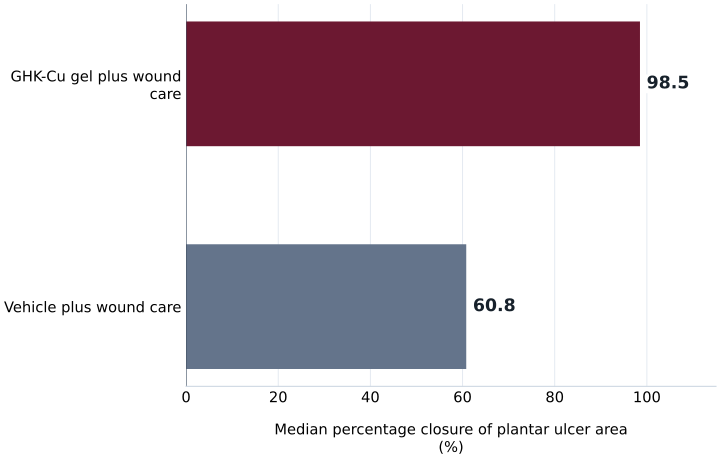
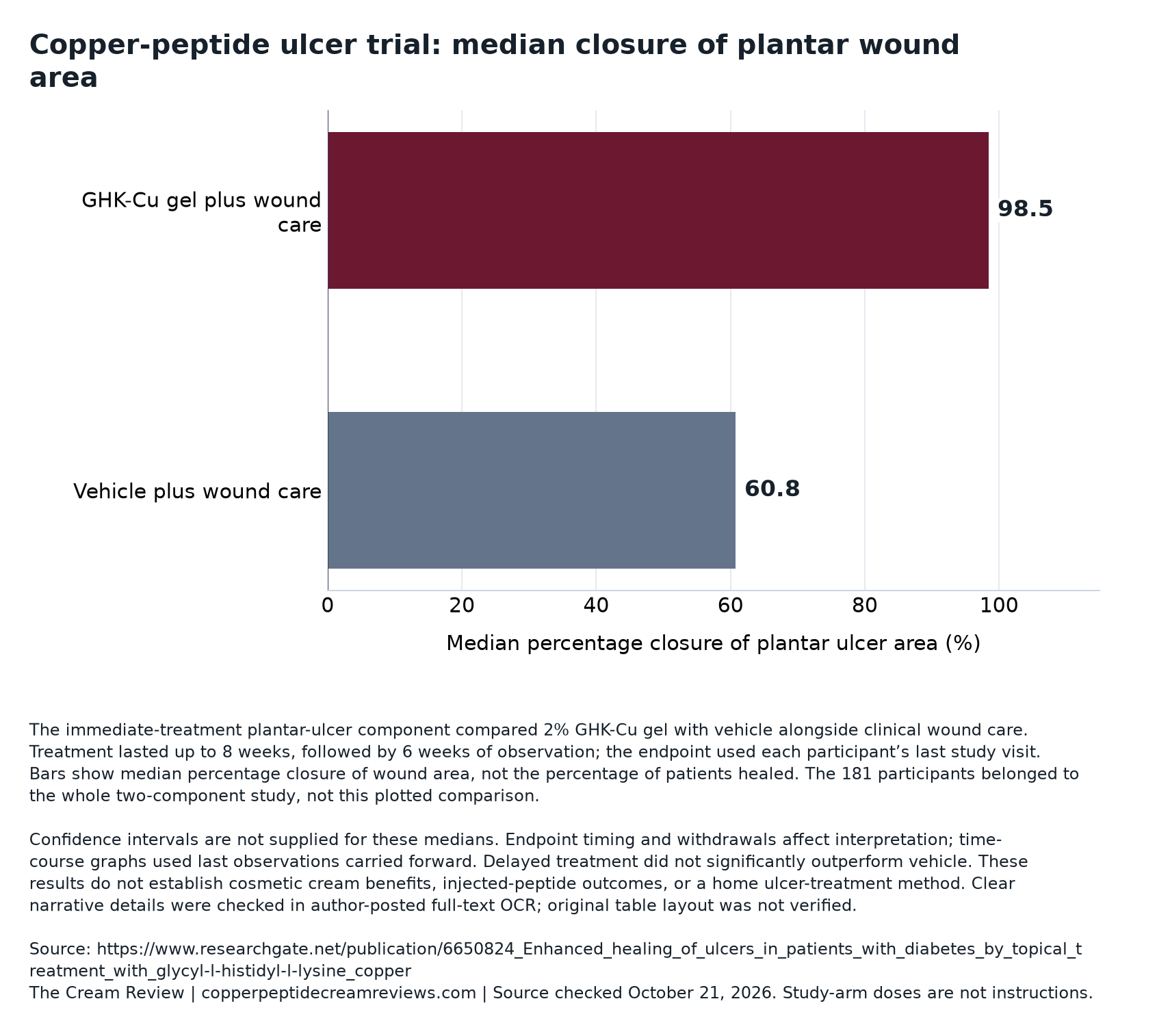
Main numerical distinction: The indexed abstract reports median plantar wound-area closure of 98.5% with gel versus 60.8% with vehicle. Source 2
Safety signal: Reported ulcer infections were 7% versus 34% in the immediate-treatment plantar subset, not across the entire trial. Source 2
Different cosmetic evidence: A separate randomized post-laser study had 13 completers and did not detect significant objective between-group improvements, despite a positive patient-reported result. Source 1
A clinical wound question, not a facial-aging experiment
The ulcer trial was multicenter, randomized, evaluator-blinded, and vehicle-controlled. Participants had diabetic neuropathic ulcers; all received standardized care including debridement, pressure-relieving footwear, and education. Its immediate-treatment comparison tested topical 2% GHK-Cu gel against its gel base. These are historical study arms, not application instructions.
That design asks whether adding the active preparation improves outcomes beyond the same underlying care and vehicle. It does not compare copper peptide with doing nothing. This distinction matters because a response in an active-treatment group combines whatever contribution comes from the ingredient, the base, accompanying care, and the wound’s trajectory. Only the controlled difference helps isolate the added intervention.
Interpretation for cream reviewing: evidence belongs first to the tested clinical question. Moving from an ulcer bed to intact facial skin changes both the biological setting and the desired outcome. The clinical-claims guide provides a practical framework for checking whether a product claim preserves that original question.
Source 2 Source 5
Read the underlying chart data: download CSV or download the source-labeled chart.
Two treatment schedules prevent a single whole-trial headline
Immediate treatment lasted up to eight weeks, followed by six weeks of observation. A delayed component used four weeks of vehicle before another eight weeks with vehicle, 2% gel, or 4% gel. Delayed active treatment did not significantly outperform vehicle. The gel used an HPMC base; concentrations identify research preparations, not equivalent retail products.
A study with several schedules cannot be summarized as one exposure applied uniformly to everyone. Timing can affect the meaning of the comparison even when the ingredient name is identical. In particular, the relevant counterfactual is the result under the corresponding comparison schedule—not an average assembled from unlike treatment histories.
The delayed result also constrains the positive interpretation. It does not establish that waiting causes treatment failure or reveal why the schedules differed. It does show why the immediate-treatment finding should not be promoted as a benefit demonstrated throughout the entire enrolled population.
How the study's comparison structure changes the question
Source 5
Area closure is a measurement, not a patient count
The reported medians differ by 37.7 percentage points. Subtracting those medians describes the separation between two group summaries; it does not calculate the extra proportion of patients healed. Nor does dividing one by the other produce a valid relative probability of complete healing. The units must remain wound-area closure.
Illustrative reasoning: suppose a hypothetical wound begins at 200 square millimeters and later measures 20. Its area closure is 90%, because 180 of its original 200 square millimeters are no longer open. That is a substantial reduction, but it is not complete closure. A different patient whose wound closes entirely contributes a different clinical outcome even if both are classified broadly as improving.
A median is the middle of an ordered distribution. It is not an average response assigned to every participant. Without the individual distribution, a high median cannot reveal how many people had persistent open wounds, how widely responses varied, or which patients improved. These are separate questions, not minor qualifications to the same statistic.
Source 2
Why a negative closure percentage can be mathematically sensible
For larger plantar ulcers, the indexed abstract reports median closure of 89.2% with gel and −10.3% with vehicle. The abstract defines larger as above 100 square millimeters; the body uses an inclusive threshold. Its OCR also describes a 10.4% increase, leaving an unresolved 0.1-point discrepancy. The broad finding is expansion in the vehicle group, not negative numbers of healed people.
Illustrative reasoning: an ulcer growing from 200 to 220 square millimeters has −10% area closure. The calculation subtracts the later area from the starting area and divides by the starting area. Growth therefore yields a negative result. This is why wound-area percentages cannot be interpreted like a survey in which every response must fall between zero and 100.
There is also a statistical asymmetry: closure stops at 100%, while enlargement can extend below −100%. A few markedly worsening wounds can consequently pull an arithmetic mean downward. A median reduces that influence, but it also leaves unanswered how severe the worst deterioration was. Neither summary alone describes the entire clinical experience.
Source 2 Source 5
The last visit is not a common fourteen-week finish line
Weekly wound tracings supported area measurement. The endpoint used each participant’s last visit, including departures for closure, adverse events, or other reasons; longitudinal graphs carried the last value forward. All 181 were included in analyses, including four with only a prestudy evaluation.
This makes the endpoint different from measuring every wound on the same calendar day. A last-visit analysis can retain participants rather than discard incomplete records, but retention in an analysis does not erase differences in observation time. Someone leaving early and someone observed much longer may contribute endpoints reached under different opportunities for improvement or deterioration.
Carrying a value forward is an analytical assumption, not another measurement. Illustratively, if a wound is last observed partially closed, repeating that value on a graph does not demonstrate that it remained stable afterward. Such methods can be useful for constructing a complete dataset, but the direction of any resulting bias depends on why observations stopped and what happened subsequently.
Source 5
Closure speed, near-closure, and statistical confidence answer different questions
The abstract describes closure as three times faster. The full report identifies a normalized linear wound-edge advance, measured in millimeters per day, rather than a tripling of healed patients. A separate near-complete-closure category is another endpoint. Reliable categorical proportions and arm counts cannot be recovered from the scrambled OCR tables.
A speed measure asks how quickly a boundary advances; an area endpoint asks how much open surface remains; a categorical endpoint asks whether a threshold was crossed. These can support a coherent picture without being interchangeable. A modest difference near a threshold may change a category, while a substantial improvement far from that threshold may not.
Confidence intervals are not supplied for the headline estimates. Reported statistical significance therefore does not tell readers the range of effect sizes compatible with the analysis. Precision matters especially for subgroup findings: a large-looking estimate may still be uncertain. The absence of an interval is a reason to withhold precision claims, not to manufacture an interval from the whole-study enrollment.
Three outcome types that should not share one headline
Source 2 Source 5
The infection result is meaningful but does not establish universal safety
The infection comparison represents a 27-percentage-point difference in the reported subset percentages. It should not be relabeled a hazard reduction: a hazard describes an event rate over time, which is not the statistic supplied here. The report also found no significant difference in overall adverse-event rates between vehicle and active groups.
The two safety statements concern different outcome sets. Fewer target-ulcer infections can coexist with no statistically detectable difference in all adverse events combined. Conversely, a nonsignificant overall comparison does not demonstrate identical safety. Event severity, timing, and the number of observations all influence what an adverse-event analysis can reveal.
Participants whose infections did not respond after a week of treatment were withdrawn. That rule makes missing subsequent observations relevant to interpretation; it does not justify assuming the missing outcomes were favorable. These findings neither establish infection prevention on intact skin nor support home treatment of diabetic wounds. They also cannot supply adverse-effect rates for cosmetic formulations or systemic injections.
Source 2 Source 5
Cell experiments support questions about remodeling, not finished-product promises
One fibroblast-culture abstract reports increased collagen synthesis without increased cell number. Another reports increased MMP-2 and its messenger RNA alongside greater secretion of TIMP-1 and TIMP-2, proteins involved in regulating matrix-degrading enzymes. Copper ions reproduced the MMP-2 effect, while peptide alone did not.
Together, these observations suggest a more complicated research question than simply whether an ingredient makes more collagen. Connective-tissue remodeling involves production, breakdown, and regulation. Observing one part of that system cannot establish the final architecture, appearance, or performance of living skin. A laboratory signal is informative because it narrows hypotheses, not because it substitutes for a clinical endpoint.
Translation would require additional links: delivery to relevant tissue, activity under actual-use conditions, and a meaningful human outcome against an appropriate comparator. None follows automatically from naming the same ingredient. Our mature-skin guide separates cosmetic priorities from biological promises, while the formula-comparison guide helps keep product-level questions distinct from ingredient-level research.
Source 3 Source 4
The laser trial offers a separate test of the cosmetic bridge
The post-laser study randomized regimens with or without GHK-Cu after circumoral carbon-dioxide resurfacing. Computer analysis and blinded assessment found no significant advantage for redness resolution; wrinkle and overall appearance comparisons were also nonsignificant at 12 weeks. A patient questionnaire favored GHK-Cu for perceived overall skin quality, with P=.04.
Objective appearance and patient experience are both legitimate outcomes, but they need different labels. Satisfaction may capture aspects of recovery that a photograph or redness measurement misses. It nevertheless cannot be rewritten as an objectively demonstrated wrinkle reduction. Likewise, improvement in both groups after a procedure does not identify the added product as the cause.
With only 13 completers and no effect-size confidence intervals in the abstract, the negative comparisons do not establish equivalence. The study also concerns recently resurfaced skin, not a routine intact-skin regimen. The separate laser-trial analysis examines this distinction in detail. Its result limits a broad cosmetic inference without disproving every possible formulation or outcome.
Source 1
What an evidence-led cream review should actually conclude
ProCyte appears through corporate affiliations, the identified study product, and acknowledgment of its development team. This documents commercial involvement, not a verified formal funding arrangement. It makes independent confirmation an important question without itself determining whether the measurements are valid.
Editorial interpretation: a reviewer should ask whether the marketed preparation has its own controlled evidence matching the promised outcome. Neither a shared ingredient name nor a stated concentration demonstrates equivalence to the trial gel. Compounded preparations, retail cosmetics, oral products, and injections cannot inherit its clinical results. Product identity and outcome identity both matter.
Contract evaluation belongs on a separate track. Readers can use the CoreAge Rx review and SuperHealthy Rx review to check documentary offer terms; those links do not imply access to the studied gel or comparable care. The cost-and-value guide similarly addresses purchasing questions, not treatment effectiveness. A clearly described offer may be easier to evaluate without being better supported clinically.
Source 5 Source 1
Questions about the evidence
Did the ulcer study show that almost everyone healed?
No. The prominent percentage summarizes wound-area reduction within a defined comparison. Establishing the proportion completely healed requires participant counts and a complete-closure definition. A middle-ranked area response cannot supply those missing pieces, even when it lies close to 100%.
Source 2 Source 5
Does randomization make every subgroup result equally dependable?
No. Randomization strengthens the assigned comparison, but subdivision leaves fewer observations and may introduce additional analytical questions. Readers still need subgroup definitions, denominators, precision, and information about how comparisons were planned. The whole-study enrollment cannot stand in for those details.
Source 5
Would a stronger cosmetic concentration reproduce the wound result?
That is not established. Concentration is only one feature of an intervention; vehicle, delivery, exposed tissue, accompanying care, and endpoint also differ. Comparing percentages on labels does not establish biological equivalence or a dose-response relationship, and the trial does not provide instructions for selecting a cosmetic strength.
Source 5 Source 3
Does a nonsignificant comparison mean nothing changed?
No. A group can improve over time without showing a statistically significant advantage over its comparator. The laser study illustrates why within-group improvement and between-group benefit must remain separate. A nonsignificant comparison also does not prove identical effects, particularly when the study is small.
Source 1
What evidence would make a facial-cream claim more persuasive?
A controlled study of the actual formulation on the intended population, with predefined cosmetic outcomes, adequate follow-up, effect sizes, confidence intervals, and adverse-event reporting would address the claim directly. Laboratory activity and wound outcomes can motivate that experiment, but they cannot replace it.
Source 5 Source 1 Source 4
What this evidence supports
The ulcer trial supports a specific clinical signal for an immediate-treatment topical gel comparison within structured diabetic-wound care. Its most important lesson for cream reviewing is endpoint discipline: area reduction, closure speed, infection incidence, and patient experience are different outcomes. The available evidence does not establish facial rejuvenation from retail copper-peptide creams. That conclusion respects the wound finding rather than dismissing it, while leaving product-specific cosmetic questions open to direct testing.
Research access and limitations
This analysis uses the indexed primary report abstracts and the available author-posted ulcer full-text OCR. The original table and figure layout was not verified, so ambiguous arm counts and categorical proportions are omitted. Laser and cell-study full texts were not examined. Confidence intervals and exact adverse-event counts are unavailable in the accessible material; no current prescribing or regulatory status is inferred from these historical reports.